
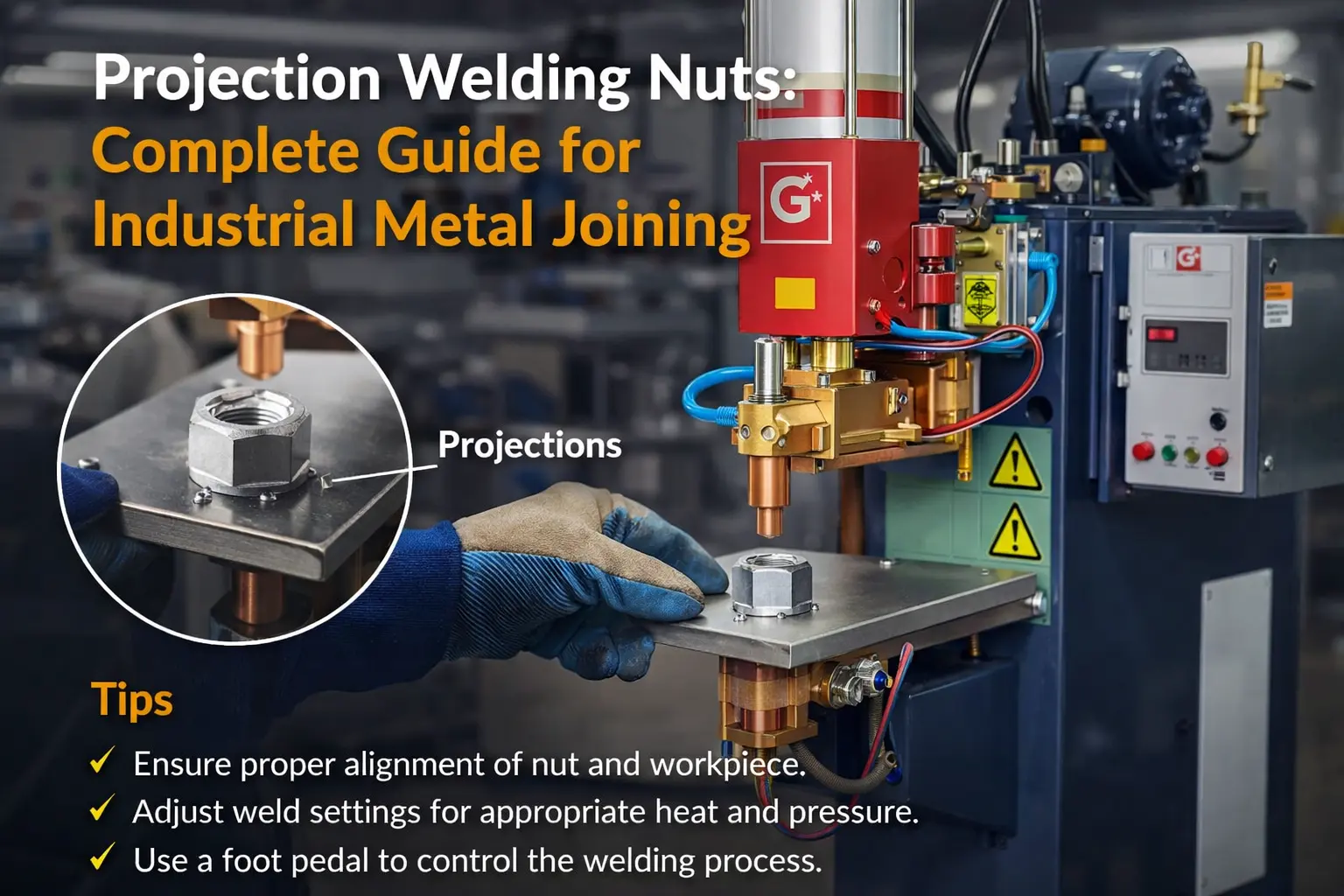
In today’s fast-paced manufacturing environment, efficiency, precision, and repeatability are non-negotiable. For industries ranging from automotive and aerospace to heavy machinery and electronics, achieving strong, reliable metal joints is crucial. This is where projection welding stands out as a versatile, high-performance solution. As a global leader in industrial welding technology, Heron Welder provides advanced projection welding systems designed to meet the demanding needs of OEMs, automation integrators, and factory production lines.
What Is Projection Welding?
Projection welding is a type of resistance welding that concentrates electrical current and pressure on small, raised projections (or embossments) on one of the metal workpieces. These projections focus the heat generated by the electrical resistance, melting the metal locally to form a strong joint when pressed together.
Unlike traditional spot welding, which applies current over a larger surface area, projection welding offers enhanced control, accuracy, and repeatability, making it ideal for high-volume industrial production.
Key advantages include:
- Consistent weld quality due to controlled heat concentration.
- Reduced electrode wear, extending tool life.
- Capability to join multiple sheets or complex geometries simultaneously.
How Projection Welding Works
The projection welding process relies on three main principles: pressure, resistance, and current flow.
- Projections Creation: One of the workpieces is prepared with small, raised points (projections) in the weld area. These can be stamped, machined, or embossed.
- Electrode Contact: Copper electrodes apply uniform pressure on the workpieces.
- Current Application: High electrical current passes through the projections. The electrical resistance at these small points generates intense localized heat.
- Metal Fusion: The projections melt and form a secure weld nugget.
- Cooling and Solidification: Pressure is maintained until the molten metal solidifies, resulting in a durable joint.
Heron’s projection welding machines feature advanced controllers and precision electrodes, ensuring consistent weld strength, minimal spatter, and optimized cycle times for automated production lines.
Applications of Projection Welding
Projection welding is widely used in high-volume, high-precision industries:
Automotive Manufacturing
- Joining sheets, brackets, and components in car bodies, chassis, and battery assemblies.
- Reducing assembly time in robotic production lines.
Electrical and Electronics
- Fabricating transformers, connectors, and battery terminals where consistent conductivity and mechanical strength are critical.
Heavy Industry & Machinery
- Welding complex multi-layer components for construction equipment, engines, and HVAC systems.
Aerospace & Defense
- Joining lightweight alloys and specialized metals where precise heat input is essential to maintain structural integrity.
Heron’s projection welding systems integrate seamlessly with automated assembly lines, ensuring productivity and quality across sectors.
Projection Welding vs. Spot Welding: Key Differences
While projection welding is often compared to spot welding, there are distinct differences:
| Feature | Projection Welding | Spot Welding |
|---|---|---|
| Heat Concentration | Localized on projections | Distributed over larger area |
| Electrode Wear | Lower | Higher due to larger contact area |
| Multiple Joints | Can weld several projections simultaneously | Typically one weld per electrode application |
| Complex Geometries | Suitable | Limited |
For manufacturers requiring high-volume, precision joints with reduced maintenance, projection welding is often the preferred choice.
Best Practices for Efficient Projection Welding
Achieving consistent, high-quality projection welds requires careful attention to process parameters:
- Projection Design: Ensure uniform size and spacing for even heat distribution.
- Electrode Maintenance: Use high-quality copper electrodes and maintain proper alignment.
- Current and Pressure Control: Fine-tune according to material thickness and type.
- Material Preparation: Clean surfaces free of oxidation, oil, or coatings for optimal conductivity.
- Automation Integration: Incorporate sensors, controllers, and robotics for repeatable precision and reduced cycle times.
Heron provides customized machine solutions and expert guidance to optimize these parameters for any industrial application.
Why Choose Heron for Projection Welding Solutions?
Heron Welder is not just a manufacturer; we are partners in industrial innovation. Our projection welding machines are engineered for:
- Reliability: Robust systems built for high-duty cycles.
- Precision: Advanced MFDC controllers ensure uniform heat and consistent weld nuggets.
- Automation Ready: Seamless integration with robotic cells and production lines.
- Custom Solutions: Tailored systems for specific materials, geometries, and production targets.
With decades of experience serving OEMs, automation integrators, and global factories, Heron ensures your projection welding operations are efficient, safe, and cost-effective.
FAQs About Projection Welding
1. What metals can be welded using projection welding?
Projection welding works best with low to medium carbon steel, stainless steel, and some copper alloys. Heron can advise on specialized alloys and configurations.
2. Can projection welding be automated?
Yes. Heron’s systems are designed for full robotic integration, offering high-speed, repeatable, and precise welding for large-scale production.
3. How does projection welding reduce electrode wear?
By concentrating current on small projections rather than a large area, the electrodes experience less surface stress, prolonging their lifespan.
4. What industries benefit most from projection welding?
Automotive, electronics, heavy machinery, aerospace, and battery manufacturing are prime users due to high-volume and precision requirements.
5. How can Heron help with custom projection welding needs?
Heron offers consultation, custom machine design, and integration services, ensuring optimal performance for your specific production line and material requirements.
Conclusion: Elevate Your Manufacturing with Heron Projection Welding
For manufacturers aiming to combine speed, precision, and reliability, projection welding is a proven solution. With Heron Welder’s expertise, advanced machines, and automation-ready systems, you can achieve consistent weld quality, reduce maintenance costs, and streamline production.
Request a quote today or consult Heron for a customized projection welding solution tailored to your factory’s needs.

 English
 Arabic
 Spanish
 Portuguese
 Deutsch
 Turkish
 Dutch
Dutch
 Italiano
 Russian
 Romaian
 Portuguese (Brazil)
 Greek
Greek