
The global food manufacturing ecosystem is undergoing a structural shift. As bakery producers and foodservice operators face increasing pressure to deliver egg-free products without compromising texture, structure, or taste, traditional formulation approaches are proving inadequate. The long-standing “Egg Functionality Gap” — replicating binding, emulsification, and aeration properties — has historically limited large-scale adoption.
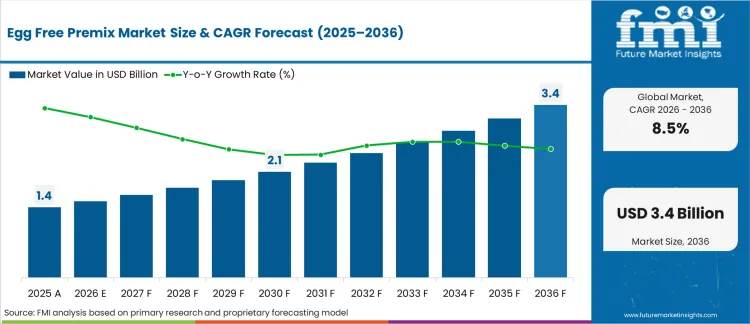
According to a comprehensive strategic outlook released by Future Market Insights (FMI), the global Egg Free Premix Market Size is projected to grow from USD 1.52 billion in 2026 to USD 3.43 billion by 2036, expanding at a robust 8.5% CAGR. This growth reflects a decisive industry transition toward technology-driven ingredient systems, where enzyme blends, hydrocolloids, and plant proteins are pre-integrated into ready-to-use premixes.
Breaking the Egg Dependency in Industrial Formulation
For decades, eggs have served as a multifunctional ingredient in bakery applications. However, volatility in egg supply chains—particularly due to avian influenza disruptions—combined with rising vegan demand, has forced manufacturers to rethink formulation strategies.
“Ingredient innovation is now outpacing consumer demand in this category,” says Nandini Roy Choudhury, Principal Consultant at FMI. “Technologies such as enzyme systems and mouthfeel chassis are closing the quality gap between egg-free and conventional products, enabling large-scale commercial adoption.”
Recent advancements highlight this shift:
- Tate and Lyle’s CP Kelco integration introduces mouthfeel chassis solutions designed to replicate egg structure in bakery and dressings.
- Novonesis launched 33 enzyme-based solutions in 2025 targeting egg functionality replacement.
- Kerry Group reported 5% bakery growth driven by enzyme and biofermentation-based egg reduction systems.
The Rise of Functional Premix Systems
The market is moving beyond simple substitution toward fully engineered premix systems that deliver consistent performance across applications.
Key Market Insights for Decision Makers:
- Bakery Premix Leadership: Accounts for 30.0% market share, driven by the complexity of egg replacement in cakes, muffins, and breads.
- Household Dominance: Captures 35.0% demand, reflecting strong adoption of plant-based baking in home kitchens.
- E-Commerce Expansion: Online retail contributes 25.0% of distribution, fueled by specialty ingredient demand and direct-to-consumer channels.
- Technology Premium: Advanced premixes incorporating enzyme systems and hydrocolloids command higher margins due to superior performance.
Regional Momentum: China and India Drive Growth
The geography of growth is increasingly aligned with vegan adoption trends and digital retail infrastructure.
- China leads with an 11.5% CAGR, supported by rapid e-commerce expansion and plant-based food culture.
- India follows at 10.6% CAGR, driven by rising health awareness and growth in home baking and food startups.
- United States remains a key value market, with USD 0.553 billion demand in 2026, anchored in vegan bakery retail and foodservice innovation.
- Japan continues to dominate in value due to its mature functional premix ecosystem.
Competitive Landscape: From Ingredients to Integrated Solutions
The competitive dynamic is shifting from commodity ingredients to integrated formulation expertise. Companies are now offering complete premix solutions backed by scientific validation and application support.
Key players include:
- Arla Foods Ingredients
- Puratos Group
- Bunge
- Swiss Bake Ingredients
- Crust n Crumb Food Ingredients
- Zion International Food Ingredients
Global ingredient leaders are also expanding capabilities through enzyme technology, hydrocolloid innovation, and plant protein engineering.
Get Access to the Full Report Sample: Explore detailed forecasts, segment insights, and competitive analysis: https://www.futuremarketinsights.com/reports/sample/rep-gb-8720
Strategic Takeaway for Executives
As egg-free formulations move from niche to mainstream, the competitive advantage lies in technology integration and supply chain resilience. Companies that invest in advanced premix systems and partner with ingredient innovators will gain a decisive edge in both performance and cost stability.
The Egg Free Premix Market is no longer defined by substitution—it is being reshaped by functional equivalence and formulation precision, setting new standards for the future of bakery and food production.
𝗪𝗵𝘆 𝗙𝗠𝗜: https://www.futuremarketinsights.com/why-fmi
Frequently Asked Questions (FAQs)
How large is the egg free premix market in 2026?
The global market is estimated to reach USD 1.52 billion in 2026.
What will the market be valued at by 2036?
It is projected to reach USD 3.43 billion by 2036.
What is the expected CAGR?
The market is forecast to grow at a CAGR of 8.5% between 2026 and 2036.
Which segment leads the market?
Bakery premix leads with a 30.0% share, due to high demand for egg replacement in baked goods.
Which end-use dominates demand?
Household applications lead with 35.0% share, driven by plant-based baking trends.
Which region is growing the fastest?
China leads with an 11.5% CAGR, followed by India at 10.6%.
About Future Market Insights (FMI)
Future Market Insights (FMI) is an ESOMAR-certified market intelligence provider serving clients in over 150 countries. Headquartered in Delaware, USA, FMI delivers data-driven insights to help businesses navigate global markets and identify high-growth opportunities.
For Press & Corporate Inquiries
Rahul Singh AVP - Marketing and Growth Strategy
Future Market Insights, Inc.
+91 8600020075
+1-347-918-3531
For Sales: sales@futuremarketinsights.com
Web: https://www.futuremarketinsights.com/

 Arabic
 French
 Spanish
 Portuguese
 Deutsch
 Turkish
 Dutch
Dutch
 Italiano
 Russian
 Romaian
 Portuguese (Brazil)
 Greek
Greek